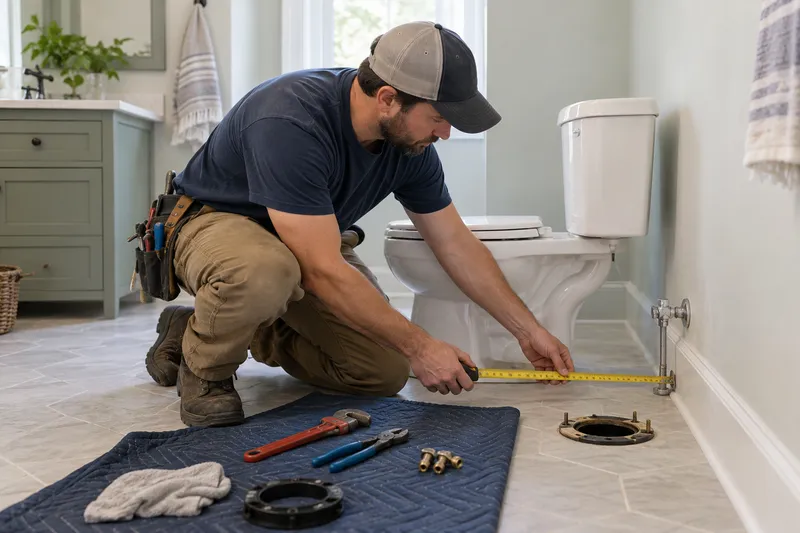
Key takeaways
- Professional toilet replacement often totals a few hundred dollars to around $1,000 including a standard toilet, with extras for flange or floor repairs.
- Measure the rough-in from the finished wall to the center of the floor bolts before buying; 12 inches is most common.
- WaterSense-labeled toilets use 1.28 gallons per flush or less, compared with the 1.6 gallon federal maximum.
- DIY can work for a straight swap, but call a plumber if the flange, subfloor or drain is damaged.
In this guide
Toilet replacement usually costs from a few hundred dollars to around $1,000 with a plumber, including a standard toilet, labor, a wax ring and supply line. Replace a toilet when it cracks, rocks despite repairs, clogs constantly or wastes water. Before buying, measure the rough-in, choose a bowl shape and height, and look for the WaterSense label.
A toilet is one of the few bathroom fixtures many homeowners can swap themselves. Still, a few measurements and checks up front make the difference between a clean afternoon project and a leak that damages the floor.
How much does toilet replacement cost?
Costs depend on the toilet you choose, labor rates in your area and what the plumber finds when the old unit comes up. These are broad ballparks.
| Cost item | Rough range | Notes |
|---|---|---|
| Standard two-piece toilet | Often roughly $150 to $500 | Most common and widely stocked |
| One-piece toilet | Often roughly $400 to $1,000+ | Easier to clean, heavier to install |
| Wall-hung toilet with in-wall carrier | Often $1,000+ plus significant labor | Requires opening the wall |
| Plumber labor for a straight swap | Commonly a couple hundred to several hundred dollars | Flat-rate pricing is common |
| Flange repair or replacement | Often around $100 to $300+ | Needed if cracked, broken or set too low |
| Old toilet removal and disposal | Often included or up to about $200 | Ask whether haul-away is included |
| Subfloor repair | Varies widely | Common after long-term leaks |
Relocating a toilet's drain is a different project entirely and can cost thousands because it involves opening floors and rerouting drain and vent lines. If you are considering that, it belongs in a broader plan; see our bathroom remodel cost guide.
Signs it is time to replace your toilet
Many toilet problems are fixable with inexpensive parts such as a flapper, fill valve or wax ring. Replacement makes sense when:
- The bowl or tank is cracked. Hairline cracks can leak or fail suddenly.
- It clogs frequently even after you have ruled out a partial drain blockage.
- It keeps running or leaking after replacing the internal parts.
- It rocks and the floor or flange is damaged, which is a good time to replace everything together.
- It is an older high-volume model. Toilets made before the mid-1990s often use far more water per flush than current models.
- You are remodeling and want a different height, bowl shape or style.
How to choose a new toilet
Rough-in size
The rough-in is the distance from the finished wall behind the toilet to the center of the closet bolts (or the drain). Measure from the wall surface, not the baseboard.
- 12 inches: the most common in U.S. homes.
- 10 inches and 14 inches: less common, often in older homes or tight spaces.
Buying the wrong rough-in either leaves a large gap behind the tank or means the toilet will not fit.
Bowl shape
- Round front: shorter, takes up less space, suits small bathrooms.
- Elongated: a couple of inches longer and often considered more comfortable for adults.
Height
Standard-height toilets typically put the seat around 15 inches from the floor. Comfort or chair height is usually around 17 to 19 inches, which many adults and people with limited mobility find easier to use. If you are planning for aging in place, also consider grab bar placement.
Gallons per flush and WaterSense
Federal standards cap new toilets at 1.6 gallons per flush (gpf). Toilets carrying the EPA's WaterSense label use 1.28 gpf or less and must meet flushing performance criteria. Dual-flush models offer a lighter flush for liquid waste and a full flush for solids.
Some local water utilities offer rebates for WaterSense toilets. Check your utility's website before buying.
Flush type
Most homes use gravity-flush toilets, which are quiet and simple to maintain. Pressure-assisted toilets flush more forcefully but are louder and cost more. Upflush or macerating toilets allow a toilet where there is no gravity drain, such as a basement, but are more complex and expensive.
DIY vs hiring a plumber
A straight replacement, same location and rough-in with a sound flange and floor, is a realistic DIY project for many homeowners. The basic steps are to shut off and drain the water, disconnect the supply, remove the old toilet and wax ring, inspect the flange, set the new ring and toilet, tighten evenly and reconnect.
Hire a plumber when:
- The flange is cracked, corroded or sits well below the finished floor.
- The floor around the toilet is soft or stained.
- The shutoff valve is stuck or leaking.
- You are moving the toilet, adding a wall-hung unit or installing an upflush system.
- You are not comfortable lifting a toilet that can weigh 60 to over 100 pounds.
If you are bundling the toilet with other bathroom work, one contractor may handle it all. Our guide on how to hire a contractor covers licensing checks and payment terms, and our tub to shower conversion guide explains a common companion project.
The bottom line
Toilet replacement is usually a modest expense, often a few hundred dollars to about $1,000 installed. Measure the rough-in, pick the right bowl shape and height, and choose a WaterSense model to cut water use. DIY a simple swap if you are comfortable, but call a plumber when the flange, floor or plumbing shows damage.
Frequently asked questions
How much does it cost to replace a toilet?
A typical professional toilet replacement often lands somewhere between a few hundred dollars and around $1,000 once you add the toilet itself, labor, a new wax ring and supply line, and haul-away. Premium toilets, wall-hung models, flange replacement or subfloor repair raise the total. Prices vary by region, so get a written quote that lists parts and labor separately.
How do I know what size toilet to buy?
Measure the rough-in: the distance from the finished wall behind the toilet, not the baseboard, to the center of the bolts holding the toilet to the floor. Most homes have a 12-inch rough-in, but 10-inch and 14-inch are also found, especially in older homes. Also check the space in front of and beside the toilet, and choose round or elongated bowl accordingly.
Is comfort height toilet better?
Comfort height, sometimes called chair height or right height, usually puts the seat around 17 to 19 inches from the floor, a couple of inches higher than older standard toilets. Many adults, taller people and those with knee or hip issues find it easier to sit and stand. Shorter adults and young children may find a standard height more comfortable.
Can I replace a toilet myself?
Many handy homeowners can replace a toilet in a few hours with basic tools: shut off the water, drain, disconnect, remove the old wax ring, set the new one and connect the supply. The job is heavy, and leaks can damage floors below. If the flange is cracked, the floor is soft or bolts are corroded, a plumber is usually the safer choice.
Official Resources & Further Reading
Use these resources to check current guidance. Requirements and availability may vary by state and provider.
This guide is for general educational purposes and is not individualized financial, legal, tax or insurance advice. Product terms, rates and availability vary by provider and location. How we make money.